< BACK TO ARTICLES 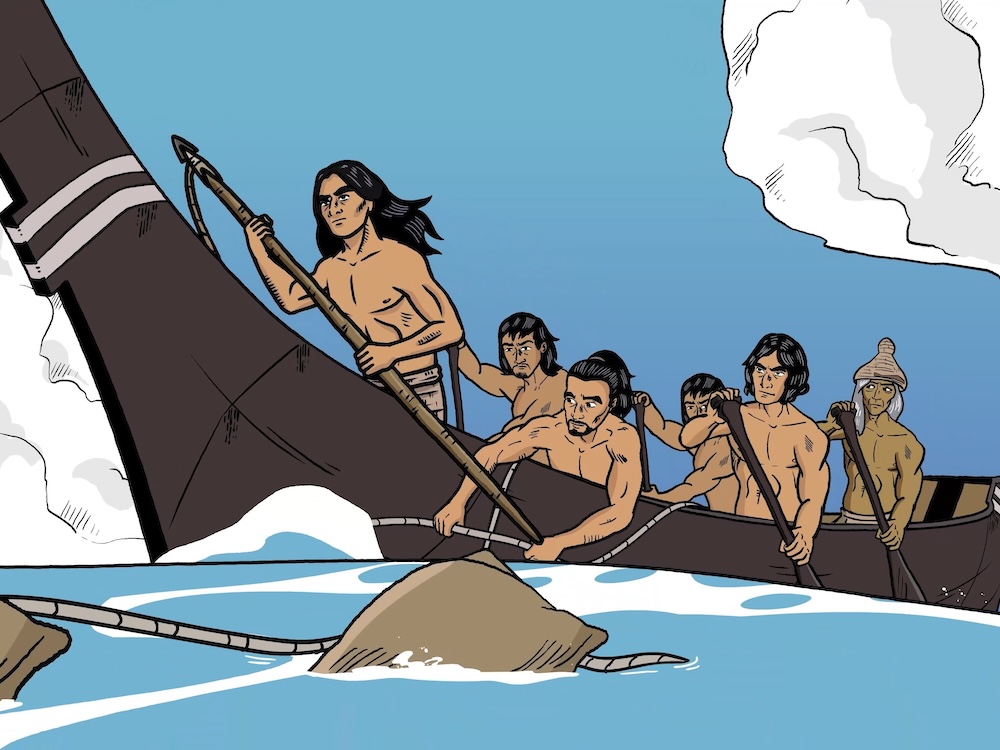
An Eye-Opening Reclamation of Indigenous History | The Tyee
April 30, 2026 1 views
EntertainmentLocal NewsLifestyleArtsIndigenous
This article is part of a Tyee Presents initiative. Tyee Presents is the special sponsored content section within The Tyee where we highlight contests, events and other initiatives that are put on either by us or by our select partners. The Tyee does not and cannot vouch for or endorse products advertised on The Tyee. We choose our partners carefully and consciously, to fit with The Tyee’s reputation as B.C.’s Home for News, Culture and Solutions. Learn more about Tyee Presents.
Animation wasn’t originally part of Tanner Zurkoski’s plan. He’d been working on documentaries for years, mostly as a production manager and line producer. Then the world changed. And as the saying goes, necessity is the mother of invention.
“When COVID hit, my documentary skill set was suddenly very irrelevant for a couple of years,” Zurkoski says. The Cree and Métis filmmaker is based on Vancouver Island. During the pandemic, he ended up working at an animation studio, where he developed a new approach to documentary filmmaking.
This new approach lends itself perfectly to Zurkoski’s feature directorial debut, Illustrated Legacies: Graveyard of the Pacific, premiering at Vancouver’s DOXA Documentary Film Festival in May.
Combining live-action documentary with animated historical re-creations, Illustrated Legacies explores moments of contact between European settlers and First Nations on the West Coast. Using interviews and archival footage, Zurkoski re-creates pivotal moments in history through animated sequences, filling in contextual gaps left by a dearth of primary sources.
Illustrated Legacies centres on the sinking of the Kingfisher trading vessel in 1864 and the associated violent confrontations between the British Royal Navy and the Ahousaht First Nation. Zurkoski’s film reveals an escalation of hostilities and trickery by British visitors to the area, and a propensity for “gunboat diplomacy.”
“I felt I could get closer... to an accurate, or at least truthful, representation of these things through animation than I could with conventional, lower-to-mid-budget documentary methodologies,” Zurkoski explains. “If I’m going to do a live-action version of this, it’s millions and millions of dollars to reach the same level of authenticity. I felt that we could achieve more through animation and get closer to that world.”
WATCH: The trailer for BC filmmaker Tanner Zurkoski’s Illustrated Legacies: Graveyard of the Pacific.
Video via Tanner Zurkoski on YouTube.
Correcting, and expanding, the record
The added layer of interpretation afforded by animation also reinforces Zurkoski’s commitment to oral storytelling traditions. Throughout the film, we hear an interplay of “official” histories and stories passed down through generations, as told by the descendants of those who lived through early colonial contact.
As with any historical document, there will be contradictions and diverging accounts. Zurkoski doesn’t shy away from this. Instead, he explicitly positions his project as a singular interpretation of events.
“This is a particular version of a story from a particular oral tradition in a particular family,” he says. “This contradicts even the oral tradition that you’re aware of. There is room for those different interpretations.”
Animated sequences work in much the same way, reconstructing versions of events with a visible intervention from the filmmakers. Animation allows for precision, but it is nevertheless a creative exercise.
“There is definitely another artistic layer that happens by depicting something,” Zurkoski explains. “It’s not vérité. You can’t point your camera at an event and it captures an objective reality. You need to design everything, from the trees in the background to the longhouse in the foreground and the person standing in front of you and what they’re holding. Everything is a choice.”
In Illustrative Legacies, the added layer of interpretation afforded by animation also reinforces director Tanner Zurkoski’s commitment to oral storytelling traditions.
Photo submitted.
The focus on such perspectives is significant. The film reclaims a narrative not widely known. Zurkoski learned about the sinking of the Kingfisher from his sister, a musician who had written a song about it. From there, the accounts he found were limited, and Indigenous perspectives were even harder to find in his archival search.
A third-generation Indigenous filmmaker, Zurkoski was already interested in Indigenous coastal histories, so he was drawn to this story and its missing pieces. By relying on oral histories, he could tell a more powerful and resonant story. The result is truly eye-opening.
Descriptions from the official record, of clashes with Indigenous Peoples, are corrected in real time by the stories that have been passed down. Animated segments clarify and contextualize otherwise puzzling historical accounts. There is a sense of justice at the core of this exercise, of correcting the record — or at least expanding it.
Illustrative Legacies reclaims a narrative not widely known. ‘This is a particular version of a story from a particular oral tradition in a particular family,’ says director Tanner Zurkoski.
Still via Knowledge Network.
While an industry veteran, Zurkoski was cutting his teeth as a feature filmmaker on Illustrated Legacies. And he found the perfect partner after meeting with the Knowledge Network.
A B.C.-based public broadcaster and streamer, Knowledge Network seeks to inform and entertain, including with programming set firmly in B.C., with Knowledge Originals focused on telling innovative and captivating stories about local communities. Knowledge is an official partner of DOXA, where its originals have premiered before.
Knowledge came on early, after a version of Illustrated Legacies was selected as part of the 2023 Indigenous Screen Summit Pitch Forum at the Banff World Media Festival. From there, Zurkoski spent three years developing the project into what it is today.
“I’ve had a wonderful time working with them,” he says of Knowledge. “As a first-time feature filmmaker, they were remarkably hands-off. They very much let me make the project that I wanted to make.”
It was a great match in part because Zurkoski had a distinct vision, which drew him to direct in the first place.
“I am super excited to get it in front of a general audience and then see what people think of it — obviously, I’ve been working on it now for three years.”
‘Illustrated Legacies: Graveyard of the Pacific’ premieres at the DOXA Documentary Film Festival on May 2, with an encore screening on May 7; both screenings will be followed by a Q&A discussion. Find tickets online. The film will be available to stream along with other Knowledge Originals on Knowledge Network in September 2026.
Read more: Film
This article is part of a Tyee Presents initiative. Tyee Presents is the special sponsored content section within The Tyee where we highlight contests, events and other initiatives that are put on either by us or by our select partners. The Tyee does not and cannot vouch for or endorse products advertised on The Tyee. We choose our partners carefully and consciously, to fit with The Tyee’s reputation as B.C.’s Home for News, Culture and Solutions. Learn more about Tyee Presents.
Original source
Read original article on Thetyee.ca