
< BACK TO ARTICLES 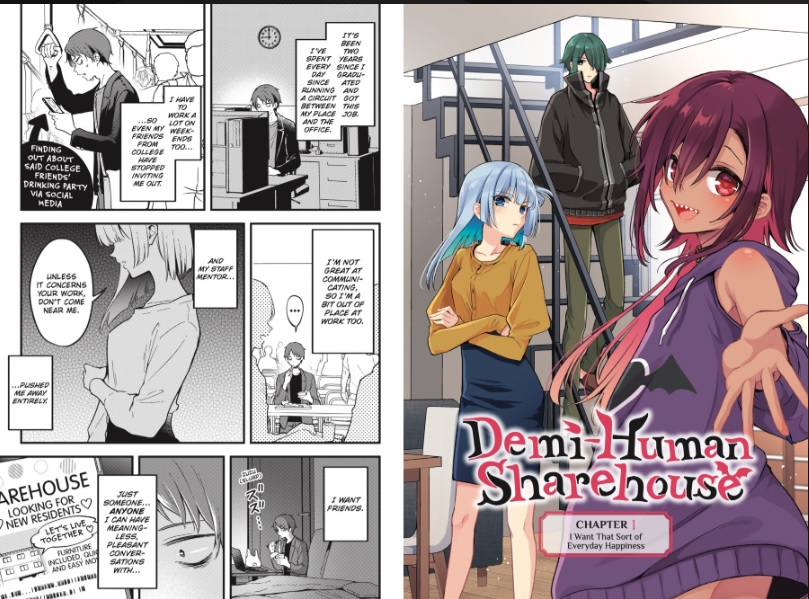
Demi-Human Sharehouse Vol 1 by Norito Asazuki Manga Review
March 11, 2026 17 views
The concept of the harem has been one of the staples of manga and anime since time immemorial, with the entries in the category being virtually innumerable. Norito Asazuki manages to turn the whole concept on its head, however, by having his protagonist end up in a house inhabited by demi-humans, in a title whose focus is definitely on sensualism.
Buy This Titleby clicking on the image below
The person of interest is Kei Sato, a corporate slave with low communication skills who applies to live in a share house, believing it will be a good way for him to make friends since he is actually as lonely as one person could possibly be. His application is accepted, but it soon turns out that his three roommates are actually demi-humans. Chiyuki is a snow woman who, every time she gets frustrated, freezes everything around her and becomes a little girl when she gets hot. Not to mention she is also Kei’s co-worker and former mentor, who repeatedly told him to stay away from her unless it was for professional reasons. Now, however, Kei starts to realize the real reasons behind her attitude.
Janome is a very tall girl with a significant bosom who also happens to be a medusa, with snakes coming out of her neck. The most intense presence, though, is Remu, an incubus who, despite appearing like a girl and constantly flirting with Kei, is actually male and can also enter Kei’s dreams and shape them, usually in suggestive ways. Soon, it also becomes clear that he is hiding something else, as are the rest of the co-renters.
The first thing one will notice is that the fan service is quite intense here in sexual terms, although the book never becomes explicit. Common showers, teasing, large breasts, underwear, and both subtle and more evident flirting fill the pages of the first volume. Consequently, these elements essentially dictate the narrative, as we watch the beginning of what will probably end up being a triple relationship of some sort.
Expectedly, this approach affects the character design, with all three demi-humans possessing a number of sensual attributes, although each in a different fashion. Remu in particular seems to be defined almost entirely through sexuality, both in appearance and attitude. Kei, on the other hand, is as plain as possible, with his appearance actually mirroring his personality and separating him strongly from the rest of the characters. Meanwhile, the attention to backgrounds is functional, with the exception of a couple of destruction scenes that are evidently more impressive.
At the same time, if one looks a bit closer at the story, a number of social comments do emerge. The loneliness Kei feels becomes a comment on life in the megalopolis, as much as on his need for connection, which eventually leads him into trouble. Furthermore, the fact that he is being exploited at work adds another layer regarding white collar mentality in the country. In addition, the issues the demi-humans face because of their difference function as a comment on the inherent racism of the country and how difficult it can be for foreigners to adjust and adapt in Japan.
It is actually this aspect that ultimately gives depth to a narrative that does not always make complete sense, allowing it to move beyond plain entertainment and into something with a bit more substance.
Original source
Read original article on Asianmoviepulse.com