
< BACK TO ARTICLES 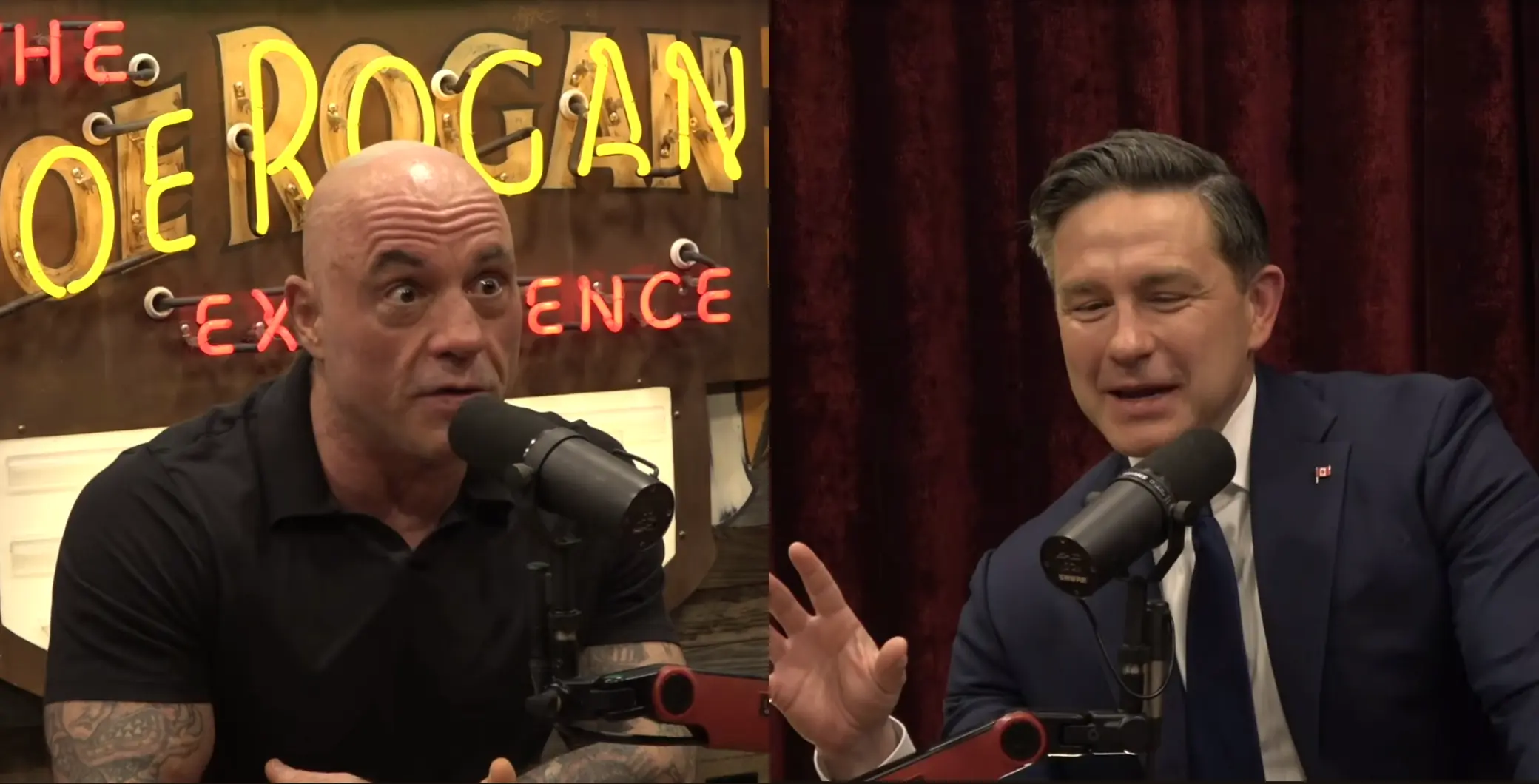
Here is a recap of Pierre Poilievre’s episode on ‘The Joe Rogan Experience’ - NOW Toronto
March 20, 2026 4 views
ShoppingPoliticsFinanceHealth
Joe Rogan and Pierre Poilievre on 'The Joe Rogan Experience'. (Courtesy: YouTube/PowerfulJRE)
Facebook
Twitter
Reddit
Copy current article link
What to know
Pierre Poilievre joined Joe Rogan on his top-ranking podcast, The Joe Rogan Experience.
In their conversation that lasted over two hours, Poilievre and Rogan talked about everything from the martial arts and public policy to the separatist movement in Alberta.
The 2,740th episode of The Joe Rogan Experience featuring Canada’s Conservative Party Leader Pierre Poilievre was over two hours long.
In case you missed it, here is an overview of the conversation.
The two kicked things off with a gift from Poilievre to Rogan – a 70-pound kettlebell with a Canadian flag, which he says was made by a gunsmith and machinist from Calgary. It was in reference to the podcast host and martial artist’s popular kettlebell workouts, and seemed to work well as an icebreaker.
The two hours and 20 minutes that ensued was jam-packed, as the two discussed everything from martial arts and sports injuries to politics and economics.
Read More
‘Everybody’s going to have an opinion,’ Canadians react to Pierre Poilievre appearing on Joe Rogan’s podcast
Poilievre’s upbringing
Advertisement
Poilievre’s upbringing is not news to most Canadians.
“My mom was a 16-year-old. She was obviously a single mom. She put me up for adoption to two school teachers,” Poilievre told Rogan.
Poilievre added he was raised in a middle-class neighbourhood with blue-collar neighbours, who he grew up thinking were overlooked by the government.
“Normal, hardworking, good folks. And I always grew up with the impression they were getting screwed over and that the government didn’t listen to people like them, didn’t listen to people who grew up on streets like ours.”
Poilievre told Rogan that the sense of injustice was what motivated him to become involved in politics.
The conversation quickly took a political turn
Advertisement
Rogan had been a vocal critic of Canada’s Liberal government, and had repeatedly refused to travel north of the border. He was particularly critical of how it handled the COVID-19 pandemic and the Freecom Convoy protestors.
“But the people are amazing,” Rogan said.
“They’re like the nicest people, and I think that’s part of what went wrong for Canada – that people are rule-followers and they’re trusting and kind.”
Also on Rogan’s list of things he doesn’t like about the Great White North: Medical Assistance in Dying (MAID).
“My view is that people should have the choice, but the concern we have is the suggestion that it would only be offered to kids or offered to people whose only condition is mental illness,” Poilievre said on the topic.
The Conservative Party had long been critical of certain aspects of MAID, calling on the Trudeau government to scrap its decision to expand the policy to cover those suffering from mental illness.
Advertisement
Poilievre offered a brief explainer of Canada’s parliamentary processes
“In our system, opposition is an act of loyalty. … If you are opposing the government, you’re doing it out of loyalty to the good of the people,” the leader of the Opposition explained.
“I don’t work for the government; I work for parliament, and parliament works for the people.”
“Canada is not for sale”: Poilievre says of Canada’s sovereignty and tariffs
Following the brief overview of the role of the Opposition in the parliamentary system, Rogan addressed the elephant in the room.
“There’s a narrative in America and the narrative is that you were about to win and your party was about to win, but then Trump came along and said he was going to turn Canada into the 51st state and everybody went crazy. Is that accurate?” he asked.
Advertisement
To which Poilievre replied, “Canada’s not for sale. We’re never going to be the 51st state.”
Rogan and Poilievre both agreed that Trump’s annexation threat was “a crazy thing to say” before pivoting to the Canada-U.S. trade relationship.
“You guys can’t make enough aluminum here; you don’t have enough bauxite or electricity to convert it,” Poilievre said.
He laid down some sound tariff logic: “A tariff does not bring the production to America. It raises the price of aluminum and therefore the F-series truck. Get rid of that tariff, you lower taxes, you lower the cost of an F-series truck for the miner in Appalachia or the electrician in Ohio.”
“It’s in America’s interest to come towards a tariff-free deal and trade freely as friends and that will be good for both of us.”
When asked whether he had spoken with Trump on matters of trade, Poilievre answered, “I believe in the rule of one prime minister at a time. … I’ve said, ‘I’ll leave it to the prime minister to do the negotiating,’ and I’ve said, ‘I’ll support him any way I can.’”
Advertisement
Poilievre says he and Carney both wanted what was “best for Canada.”
Poilievre touted Canada’s abundance in resources
From oil and uranium to potash and natural gas, Poilievre said “unblocking our resources” would be the first thing he would do should he become prime minister.
“We have it all,” he said.
“And what I want to do is unblock those resources, produce them in abundance for ourselves and our allies.”
According to him, Canada’s red tape and bureaucracy around developing its natural resources is limiting the country’s abundance.
Advertisement
“There’s a problem with bureaucracy just growing way too damn big. … There’s nothing you’re going to learn in year 14 of a review that you couldn’t have learned in month 14.”
Poilievre also said he would streamline the timeline and offer pre-approved permits so that projects can get a headstart – a concept of ‘shovel-ready zones’ that the Conservative Party had been pushing for some time now.
He defended Alberta’s oil production from Rogan, who was under the impression that the practices in the Energy Province were destructive and “horrible.”
“We have the best industry, the most responsible industry anywhere in the world,” Poilievre said.
“It’s been a really disgusting PR campaign by extremist environmentalists and frankly some of our competitors to try and make our industry look bad.”
“Yeah, they got me,” Rogan said.
Advertisement
Poilievre says overprinting money is “the biggest fraud perpetrated on the working class people in the last hundred years”
Cost of living and high inflation was a significant topic of discussion between Poilievre and Rogan.
“If you had a law saying you can’t actually bring a proposal to cabinet unless you have matching savings to pay for it, you’d have these politicians walking up and down the hallways in the departments looking for waste and rooting it out,” Poilievre said of his opposition’s policy proposals that came without budget considerations.
Poilievre says the elites of Canada and other Western nations (including the U.S.) have benefited from inflation at the expense of the working class.
Matters of affordability were peppered throughout the entirety of the conversation, spanning across discussions of tariffs, immigration, and drug addiction.
Poilievre says Canada’s immigration and refugee policies partly to blame for the country’s economic deficit
Advertisement
“We’re giving a lot of money to fake refugees – people who come in and are not actually fleeing danger,” Poilievre said.
“I love real refugees. My wife was a refugee, but I have no time for people who are pretending but they’re not really.”
When Rogan asked him what he meant by “pretending to be a refugee,” Polievre replied, “They’re not actually endangered in their home country. So they’ve come to declare themselves as students and then want to stay declaring a refugee status.”
He says he doesn’t “begrudge them as people” but that they take away resources from hard-working Canadians – the consequence of which Poilievre says is “a challenge” that the federal government is currently working to “unwind.”
“When their work permit and their visitor visa runs out, then we have to encourage them to head back lawfully,” he told Rogan.
However, Poilievre said Canada doesn’t want to do it “ICE-style” – referring to the raids by the U.S. Immigration and Customs Enforcement south of the border, some of which had ended in violent protests and even deaths.
Advertisement
Poilievre says Canadian justice system “way too soft”
Of course, Poilievre and bail reform is also an adage as old as his time as the leader of the Opposition. He had long been critical of the Liberal government’s “soft-on-crime” policies, and pushed for a bail reform.
“We all believe in the basic principle that you’re innocent until proven guilty,” he said to Rogan.
“But if someone convicted has like 150 prior convictions and they’re newly arrested on their latest crime, I don’t think we should be releasing them onto the streets.”
Rogan echoed the same concern of the American justice system, calling it “bananas.”
Rogan says Canadians “so polite” after Poilievre refuses to badmouth Carney
Advertisement
“How the hell did you lose?” Rogan asked Poilievre regarding the last federal election. “How can a rational person not vote for that?”
Poilievre told Rogan he will continue to “keep pushing [his] ideas” and that he thinks the Conservative Party will “overwhelmingly” win the next election.
And though he got worked up over his party’s differences with its opposition, Poilievre refused to speak badly of the prime minister to Rogan.
“I won’t criticize him on foreign soil,” he said. “We have a mutual respect.”
Poilievre and Rogan talked at lengths about health, fitness, and martial arts
From processed foods and gut bacteria to jiu-jitsu and kettlebell exercises, Poilievre and Rogan seemed to find common ground on matters of physical wellness.
They also went off tangent on topics of cattle farms, glyphosate as a herbicide, and the obesity rate in the Asian population.
Eventually they landed on the opioid crisis and the impact of addiction
“One of the things we’re focused on in my plan is massive treatment and recovery programs to get people off drugs,” Poilievre said.
The two talked at length about the prominence of the opioid crisis on both sides of the border and the importance of public information.
The two discussed sports, MMA, and UFC for roughly 30 minutes before ending up at Alberta’s separatist movement
“What was that about?” Rogan asked.
“It won’t happen,” Poilievre shut him down.
The Calgary-native says there are some “legitimate frustrations” from Albertans but that “at the end of the day, Canada’s going to be united.”
“If I was Canadian I would vote for you 100%”: Rogan
Rogan, who had sworn off Canada, promised Poilievre he would visit should he become prime minister.
“You look at that maple leaf on your new kettlebell everyday,” Poilievre told the podcast host.
Emily Hwang
Advertisement
Twitter
Tiktok
Instagram
Youtube
Facebook
Threads
Blue Sky
Follow us @nowtoronto
Advertisement
What’s Trending
Posted 4 days ago ‘Failed politician struggling for relevance,’ Kevin O’Leary’s loud Oscars appearance has banded the internet together to roast him
Posted 2 days ago ‘Building friendships is hard,’ These Toronto residents are hosting events to combat loneliness in the city
Posted 5 days ago ‘I’m not playin’ with y’all,’ Cardi B calls out Canadian fans for not selling out her show at Hamilton’s TD Coliseum
Advertisement
Original source
Read original article on Nowtoronto.com