
< BACK TO ARTICLES 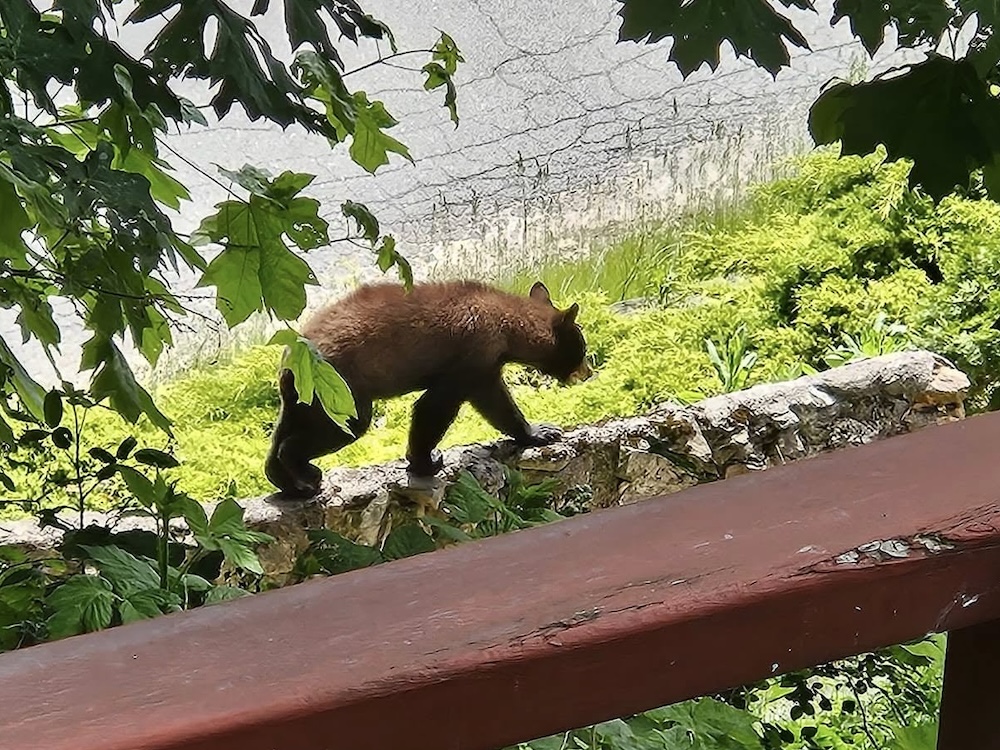
Should You Snitch On Your Neighbourhood Bear? | The Tyee
March 3, 2026 21 views
FoodPoliticsLocal NewsPetsReal EstateHome GardenEducationAutomotiveEnvironment
Mollie Cameron remembers her first bear encounter in her new home of Sooke.
Announcements, Events & more from Tyee and select partners
The Tyee Is Recruiting Our Next Editor-in-Chief
Founding editor David Beers is passing the baton to a new leader. Is it you?
Ensemble Made in Canada Champions Nation’s Composers
The Juno-winning piano quartet will play an intimate salon-like concert at the Chan Centre’s Telus Studio Theatre.
“I was driving home one night and a dog ran out in front of my car,” Cameron recounted. “I opened the back passenger door to get the dog in to go find its owner, and the dog grabbed a tree and looked at me.”
Only then did she realize the animal was a black bear.
Being in a wilderness area, where the bear was simply moving through its habitat, Cameron backed away, got in her car and left. But on the off chance the bear had reacted aggressively, or started eating garbage, she wouldn’t have known back then whom to call.
Today, years later, Cameron leads a wildlife awareness initiative called Wild Wise that advocates for an education-first approach to help B.C. residents change their behaviour and coexist with bears.
Her work includes encouraging people to call in bear sightings to the province’s Report All Poachers and Polluters line — a phone number B.C.’s provincial conservation officers monitor for reports of human-bear interactions. The RAPP line, as it’s widely known, is a central hotline for cities, wildlife non-profits and residents to direct bear sightings and concerns.
But a misconception for some residents that most reported bears are killed has left some people unwilling to call the RAPP line when they see bears in their neighbourhood. Sometimes, it takes a bear entering a property or even a house for a resident to finally call, at which point conservation officers must intervene.
Recognizing that distrust, some municipalities and non-profits are pushing for callers to report more of their bear sightings to them, and not always to the Conservation Officer Service.
Some municipalities fear that unreported animals will impair their ability to help residents secure garbage and attractants before bear encounters escalate — and they do have to be killed. To ensure residents are still reporting, communities have come up with different directives on whether to call the RAPP line, bylaw services or wildlife groups about that bear in your neighbourhood. For the caller, the right choice isn’t always straightforward.
Why bears are reported to the RAPP line
Imagine going for an afternoon stroll around your neighbourhood block. You notice a mid-size black bear calmly wandering along the street a safe distance away.
Should you post about it on your community Facebook page? Does your municipality want you reporting sightings to the Conservation Officer Service? Is there a local non-profit you can quietly inform instead? Or, is it simply best to just leave it alone?
The Conservation Officer Service, non-profits and local governments all encourage reporting bears to the RAPP line, particularly if a bear is aggressive, threatening or a public safety risk.
On social media, some residents worry that reporting to the Conservation Officer Service automatically gets bears killed. Instead of calling the RAPP line, residents suggest leaving urban bears unreported, allowing them to move on undetected.
But that approach can lead to harm, Cameron says. Early intervention can help residents avoid bear encounters and bear deaths — but only if communities know that bears are visiting. Without conservation officers and non-profits made aware of local bears, they aren’t able to identify the source of human-bear conflict and change the behaviour of residents that’s attracting bears.
“If you’re not calling, and then behaviours are escalating behind the scenes and there’s no awareness, and then all of a sudden there’s this bear that’s breaking into homes or vehicles, it kind of eliminates that ability to have that proactive educational response,” Cameron said.
Bear non-profits stress that reporting a bear usually does not lead to its death and point to provincial statistics as proof. B.C. residents made 13,672 bear-related RAPP line calls in 2025, and 211 bears were killed, the Conservation Officer Service reported.
RELATED STORIES
Charting a Course Through Bears’ Eyes
Cameron noted that when conservation officers receive reports of a bear passing through a neighbourhood without posing a risk, they sometimes decide a response is unnecessary.
If bears are in interface or wilderness areas, many — but not all — municipalities and organizations say observers don’t need to bother calling BC’s RAPP line.
Photo by Magdalena Nodzykowska.
Report every bear? Cities differ
For residents who encounter a non-threatening bear, the suggested course of action depends on local government preferences and programs.
Some cities prefer to leave bear calls to the RAPP line, while others offer a middle ground, welcoming calls to their bylaw services or local non-profits so they can provide education on human-bear safety and attractant management.
Calls about fearless bears eating human-supplied food or roaming schoolyards or city parks should go to the RAPP line, WildSafeBC says. However, not all bear sightings need to be reported, some RCMP detachments say. Many non-profits agree, if bears are seen in nearby woods or “wildlife interface.”
In Prince George, bylaw services manager Kent MacNeill said residents generally have good judgment on whether to call the RAPP line. A smaller bear harmlessly roaming a fairly urban area “may not elicit a call,” he said, whereas an aggressive one that won’t leave a resident’s garbage likely will.
Regardless of how big or small the issue, MacNeill suggested the municipality is happy to field complaints from residents about both bears and attractants in the community.
“I don’t think necessarily people understand our bylaw services role, and how we can effectively manage wildlife attractants and bear-related issues,” MacNeill told The Tyee. “I personally think we could probably get more calls from the general public. Sometimes it’s more effective to call us and not the conservation service, especially when it’s an attractant issue.”
In Kamloops, meanwhile, city officials ask people to report all bears and human-bear interactions straight to the Conservation Officer Service.
“We do not want to get any reports to the city and we’ve never encouraged that,” environmental services supervisor Danielle Sparks said. “It all needs to be going through one source.”
The North Shore Black Bear Society, which receives 1,500 to 1,800 wildlife reports annually, takes a different approach for North Vancouver and West Vancouver residents.
Bear sightings can be reported via a “bear line” funded by the District of North Vancouver. Callers can choose to refer their information to either the society or the Conservation Officer Service, or COS.
North Shore Black Bear Society executive director Holly Reisner said that ensures even residents who distrust conservation officers still have a place where they feel comfortable sharing sightings. Calls to the society are never shared with either the Conservation Officer Service or the RCMP, so residents’ reports won’t lead to a bear being harmed by authorities, Reisner said.
Still, residents who encounter a bear and feel concerned for their own safety shouldn’t be discouraged from calling the RAPP line, she said.
“We would never tell residents not to report to COS,” Reisner told The Tyee. “Sometimes they’ll call the RCMP as well. I’m never going to be in a situation where I tell them not to.”
Conservation officers and RCMP sometimes share information about bear incidents with the North Shore Black Bear Society, including approximate locations. That allows Reisner and volunteers to visit residents and provide information to foster better coexistence with bears — something conservation officers aren’t always available for.
With about 160 officers assigned across B.C., the Conservation Officer Service doesn’t have the staff power to directly engage residents about every bear report. That’s especially true in rural regions, said Angelika Langen, who helps run the Northern Lights Wildlife Society in Smithers.
With the distances conservation officers have to cover, “there’s only so much... they can do,” Langen said.
She said local governments should “stand up” on their own for bear management, rather than have the Conservation Officer Service shoulder all the calls and response. That requires funding bylaw enforcement officers to uphold rules around handling of garbage and other bear attractants.
Some municipalities have hired officers specialized in human-wildlife safety and versed in B.C.’s Bear Smart Community Program. Whistler’s local government funds both a Bear Smart program assistant who handles community outreach and a wildlife safety response officer who supports the Conservation Officer Service and assists outreach to reduce conflict.
The two positions are guided by the region’s conservation officers and the messaging they share with the public, Whistler communications manager Jennifer Smith told The Tyee.
The Conservation Officer Service has also periodically funded a wildlife response officer for the Kamloops region. Sparks said the role has helped ensure that municipal community services officers — who assist bylaw education and enforcement for human-bear conflict — are on the same page as conservation officers and WildSafeBC about bear messaging.
“We put a lot of thought into consistent messaging,” provincial WildSafeBC co-ordinator Kathy Murray said. “It’s got to be straightforward, clear and factual.”
Even as it encourages residents to report aggressive and threatening bears, the Conservation Officer Service itself said it also is trying to reduce RAPP line calls. For non-urgent bear reports, WildSafeBC directs residents to an online RAPP reporting form that lets respondents submit anonymously.
Advocates and municipalities say reducing human-bear conflicts requires reducing access to human food sources.
Photo by Brian Aikens.
Is a fed bear really a dead bear?
Though experts agree that securing attractants remains the best way to keep both humans and bears safe, communities differ about the commonly espoused idea that “a fed bear is a dead bear.”
It’s a motto that has been preached by the B.C. government for decades.
And it’s been used by many communities, including Kamloops, because bears habituated to non-natural food sources “typically are not candidates for relocation or rehabilitation,” Sparks said. The city’s bear messaging is developed by a committee that includes the Conservation Officer Service, WildSafeBC and local government departments.
But not everyone uses the line.
The North Shore Black Bear Society explicitly avoids it, along with the descriptors of “food-conditioned” and “garbage” bears.
“Those are messaging terms that we would like to see dropped, because it does provide a false understanding of the bear’s motivation,” Reisner said. “If human-provided food is consistently made unavailable, bears will go back to their natural food source.”
WildSafeBC, in messaging that is peer reviewed by the Conservation Officer Service and shared with local governments, agrees that “a fed bear is a dead bear.” Still, conservation officers may be able to turn bears off human-supplied food and back to natural food sources and habitat if residents proactively call the RAPP line, Murray said.
Whistler has demonstrated that bears can be turned away from trash by employing bear-proof municipal garbage bins and directing residents to odour-controlled waste transfer stations, rather than allowing them to leave waste curbside.
Charting a Course Through Bears’ Eyes
read more
In his lifetime, Mayor Jack Crompton has watched this transformation. He remembers visiting Whistler’s former Cheakamus Crossing landfill as a child with his grandfather to watch bears feast on unsecured waste. Today, garbage is tightly controlled and sealed off at the municipality’s transfer stations, and Whistler is working to improve awareness about human-bear coexistence, including the role of the RAPP line.
“That effort is incredibly complicated, but I think we’re getting better at it every year,” Crompton said.
For B.C., the statistics seem promising. Recent years have seen a significant drop in conservation officers killing black bears. In 2025, 211 bears were killed, a substantial decline from the 303 bears killed in 2024 and 603 killed in 2023. The year marked the fewest bears killed and the fewest RAPP line calls since the Conservation Officer Service began posting its data in 2011.
Murray said residents in communities across B.C. must continue to spread the messaging about how they should respond to neighbourhood bears, whether calling the RAPP line or cracking down on their own attractants. But first, municipalities must ensure the message that they’re pushing is clear and consistent, so residents aren’t left unsure.
“At the end of the day, I think it’s in everyone’s best interest to be on the same page.”
Read more: Environment
Original source
Read original article on Thetyee.ca